



SOURCES
Every knowledge source connected
Source code, developer chats, ticketing systems, and runtime monitoring ingested simultaneously, regardless of which system or vendor they originated in.
IT · Application Development · All Industries
The people who understand your most critical legacy applications are retiring, taking decades of undocumented knowledge out the door with them. Squirro + RMJ2 captures scattered knowledge from source code, developer chats, tickets, and runtime behavior, structures it into a queryable knowledge graph, and turns it into the knowledge foundation needed to drive the modernization of legacy software applications.
Trusted by Industry Leaders
Measurable Impact
Knowledge preserved permanently, independent of the people who held it.
What It Does
Critical legacy applications rarely fail because the code is bad. They become a liability because the people who understand them are retiring, the documentation is absent or untrusted, and the knowledge lives scattered across the organization, including in legacy source code, developer chats, ticket threads, runtime logs, and the heads of a shrinking group of senior staff. Squirro + RMJ2 uses agentic RAG grounded by a knowledge graph to answer questions across your source code, chats, tickets, and runtime behavior, retrieving cited answers your teams can rely on.
2.1s3.4s2.8s1.9s3.2s1.6sAnalysed the full change scope and its dependencies: 4 modules, 11 subprograms, 6 copybooks, 3 associated 3270 screen formats, and 2 business rules.1
The program runs 10–15 times daily between 22:00 and 23:00 as a BMP job, with a documented fallback restoring service within 1–2 minutes. SLA is 98% availability, currently measured at 99.5%. Business criticality: moderate.23
The workaround is a manual database update carrying a risk of data inconsistency. Two open tickets relate to this program, neither affected by the change.4
A draft test plan covering the impacted paths is attached with the relevant change documentation. The original developer has left the organization – knowledge and dependencies retrieved from the graph.5
Note for planning: the business owner is on leave for two weeks, and a change freeze begins two weeks after that.6
How it works
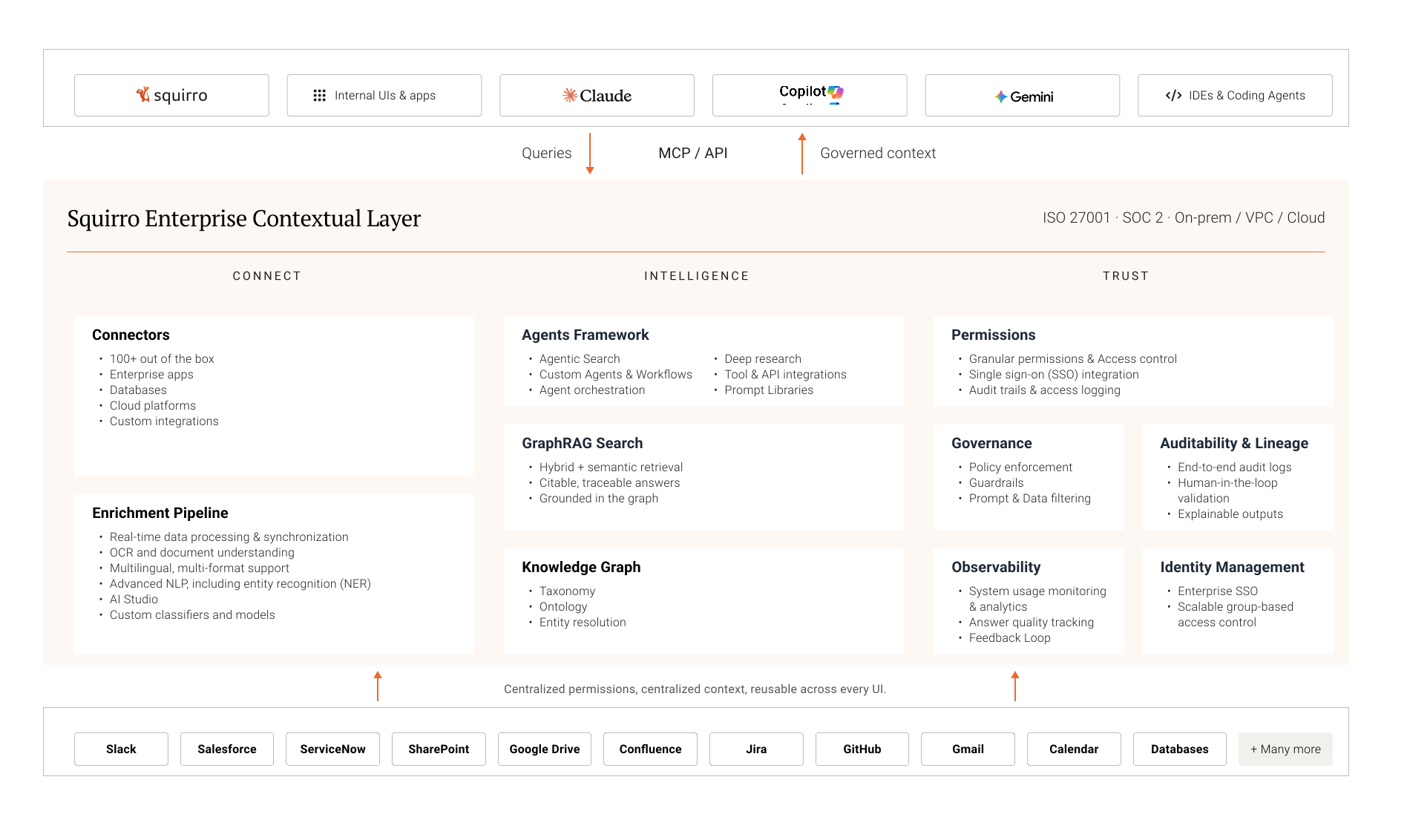
Application knowledge lives in silos that do not connect, including source code in one system, incident history in another, and runtime behavior which is not stored anywhere. Squirro + RMJ2 ingests every source into a single knowledge graph, then uses RAG grounded against that graph to answer any question in plain language, cited back to the original artifact, retrieved at query time rather than trained into a model.
SOURCES
Source code, developer chats, ticketing systems, and runtime monitoring ingested simultaneously, regardless of which system or vendor they originated in.
KNOWLEDGE GRAPH
Code, tickets, change records, and runtime behavior connected into a single queryable model of how the application actually works, not just what the code says.
6 typesstaticstaticstaticticketsruntimederivedGROUNDED ANSWERS
Developers ask in plain English. RAG retrieves the relevant knowledge from the graph and grounds the response in it, cited to the exact source artifact, with no escalation to the one person who knows.
Three programs write to CLAIMS_HIST: PAYCLM01 and CLMPOST through embedded SQL, and CLMARCH through dynamic SQL built at runtime — the last one is visible only in the execution traces.12
A schema change would break two batch jobs: PAYNITE (BMP, nightly 22:00–23:00) and CLMARCHW (weekly archive). Both have documented fallbacks; the archive job has none for a partial run.3
CONTINUITY
Continuous pipelines keep the model up to date as sources change. The knowledge remains permanently, independent of the individuals who held it.
22:14Merge !4821 · 3 programs re-indexed, 2 new CALL edgesGitLab22:15INC-48377 closed · resolution linked to CLMPOSTServiceNow22:41PAYNITE run · execution trace captured, dynamic SQL re-resolvedRuntime23:0214 messages parsed · 2 answers linked to map CLM020TeamsFriAccount of R. Haller (retired) archived · 312 authored artifacts remain in the graphDirectoryEFFICIENCY
In most application environments, agents and developers spend more time locating information than producing answers. The knowledge graph collapses that search step – cutting time to answer and sharply reducing the token cost of every query.
Integrations
Break down data silos and integrate all of your existing data, creating a single source of truth.
Your Expansion Path
Each stage increases automation depth and adds intelligence. This is a transformation journey, not a standalone tool.
Knowledge graph across source code, chats, tickets, and runtime behavior. Natural language Q&A with cited answers. Live in 6–8 weeks.
The same knowledge model applied to IT support, with common application questions resolved instantly, escalations reduced, senior staff freed for genuinely complex work.
The knowledge graph becomes the foundation for modernization. Architecture teams query dependencies, behavior, and interactions before writing a line of migration code, replacing the stalled pre-study.
A continuously learning model of your entire application estate, spanning knowledge preservation, support deflection, modernization, and autonomous issue resolution, compounding with every system it ingests.
Our Platform
Most enterprises rebuild the same plumbing for every AI project — connectors, governance, retrieval, audit. Squirro builds it once. You extend it.
One Platform. Limitless Workflows. Ready to Deploy.
Ready to Deploy
Retiring application knowledge, stalled modernization pre-studies, and slow fault diagnosis create technical friction differently in every organization, so we are mapping the most strategic path to value with a handful of technology teams.
Share your details below for early access, a look at how this fits your stack, or a voice in how it gets built. A few quick questions, then, if it makes sense for both sides, a 20-minute conversation. No pitch.