



Case Study · Advanced Manufacturing
“I didn’t know this level of accuracy was achievable.”
Managing Director, global advanced manufacturing company
Why accuracy is a design decision, not a model choice, and what co-optimizing five elements made possible.
Manufacturers in advanced electronics, industrial machinery, materials testing, and specialty chemicals bring us the same problem: decades of technical knowledge exists in documentation and service records, but search fails to surface it reliably.
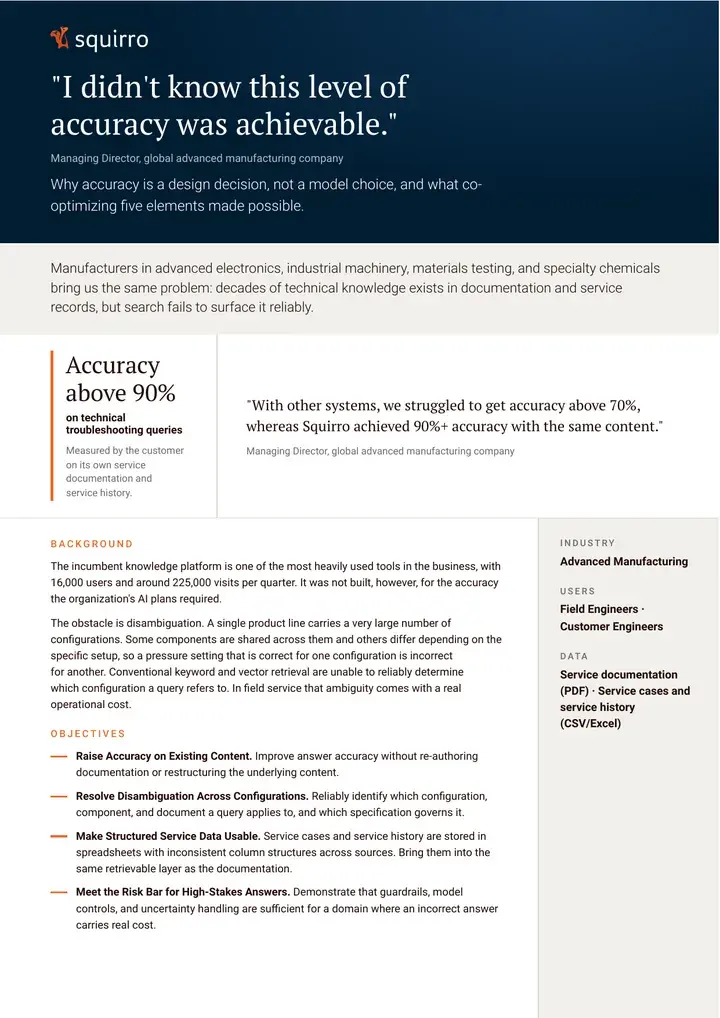
“With other systems, we struggled to get accuracy above 70%, whereas Squirro achieved 90%+ accuracy with the same content.”
1
Background
The incumbent knowledge platform is one of the most heavily used tools in the business, with 16,000 users and around 225,000 visits per quarter. It was not built, however, for the accuracy the organization’s AI plans required.
The obstacle is disambiguation. A single product line carries a very large number of configurations. Some components are shared across them and others differ depending on the specific setup, so a pressure setting that is correct for one configuration is incorrect for another. Conventional keyword and vector retrieval are unable to reliably determine which configuration a query refers to. In field service that ambiguity comes with a real operational cost.
2
Objectives
-
Raise Accuracy on Existing Content
Improve answer accuracy without re-authoring documentation or restructuring the underlying content.
-
Resolve Disambiguation Across Configurations
Reliably identify which configuration, component, and document a query applies to, and which specification governs it.
-
Make Structured Service Data Usable
Service cases and service history are stored in spreadsheets with inconsistent column structures across sources. Bring them into the same retrievable layer as the documentation.
-
Meet the Risk Bar for High-Stakes Answers
Demonstrate that guardrails, model controls, and uncertainty handling are sufficient for a domain where an incorrect answer carries real cost.
3
Solution Highlights
Five Elements, Tuned Together
- 01Orchestration
- 02Taxonomy and Ontology
- 03Guardrails
- 04Governance
- 05Retrieval Architecture
Accuracy came from simultaneously co-optimizing five elements: orchestration, taxonomy and ontology, guardrails, governance, and retrieval architecture. The customer reported that flexibility across all five raises the accuracy ceiling, including the ability to adjust chunking and ingestion on the fly and to build custom ingestion pipelines.
-
Taxonomy, Ontology, and Knowledge Graph Control
Squirro’s Graphite gives direct control over taxonomy, ontology, and knowledge graph structure. That is the layer encoding which components are shared across configurations, which differ, and which document governs each setup.
-
Semantic-First Hybrid Retrieval
Retrieval leads with semantics inside a hybrid architecture, rather than treating semantic search as a layer added on top of keyword matching.
-
Guardrails and Model Control
Enforced guardrails the system is designed not to route around, configurable agent personas, and direct control over model temperature.
-
Human Judgment at the Decision Point
The system surfaces grounded answers and flags its own uncertainty. The engineer on site remains the decision-maker, and complex cases escalate to senior staff.
In an industry where small inaccuracies can have $10M consequences, our AI team needed reassurance that Squirro could deliver an extremely high level of precision.
I’ve spent a lot of time working with probabilistic models and LLMs. I didn’t know this level of accuracy was achievable.
4
Outcomes
-
01
Accuracy Above 90%
Answer accuracy on technical troubleshooting queries, measured by the customer on its own service documentation and service history.
-
02
Disambiguation Across Configurations
Graph-encoded relationships between configurations, components, and documents let retrieval identify which specification applies to the equipment in question.
-
03
Structured Service Data Brought into Scope
Service cases and history previously locked in inconsistent spreadsheet formats became retrievable alongside documentation, without a separate data unification project.
-
04
A Skeptical AI Team Satisfied
The internal group with the deepest understanding of where LLM systems fail was the group that had to be convinced. After evaluation, they approved the system.
5
Where This Goes Next
The value the organization is building toward is the transfer of expertise. Complex troubleshooting cases escalate to senior engineers who are already stretched. Resolving a meaningful share of them on site would relieve that pressure and allow field engineers to work more independently.
“The biggest opportunity and challenge for LLMs across industries is delivering expert knowledge to junior members of the workforce. Squirro has allowed us to scale expertise in a way we never thought possible.”
6
Why Squirro
- Co-optimization across all five elements of high-accuracy retrieval
- Direct control of taxonomy, ontology, and knowledge graphs
- Semantic-first hybrid retrieval architecture
- Enforced guardrails and model-level controls
- Proven in manufacturing and highly regulated environments at scale
Case Study PDF
Keep the Two-Page Version.
The full case study as a PDF, to read offline or share with your team.
PDF · 2 pages · 147 KB
Next Step
Ready to Raise the Accuracy of Your Enterprise Search?
Explore the technology behind the Squirro Enterprise GenAI Platform.