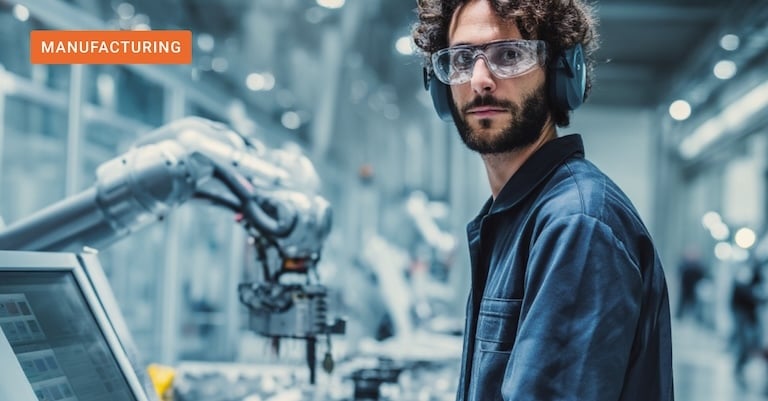

Picture the floor of a high-tech manufacturing facility – automated production lines, uninterrupted operation, minimal human intervention. Yet despite the millions invested in advanced robotics and precision engineering, the remaining operator experience often remains trapped in the past – anchored to physical buttons and deeply nested touchscreen menus.
As production demands accelerate, these legacy interfaces often struggle to keep pace. Operators spend months studying thick technical manuals just to configure routine tasks. This steep learning curve creates operational bottlenecks and restricts the agility required in modern production environments.
The Limitations of Legacy Industrial Interfaces
Traditional human-machine interfaces rely on rigid, pre-programmed logic trees, limiting the efficiency of the of industrial machines and the people that operate them. Users often find themselves manually translating complex industry standards into highly specific software parameters.
This manual data entry isn't only slow, it's also prone to human error and deeply dependent on tribal knowledge that is rapidly exiting the workforce. When physical hardware lacks seamless access to an enterprise’s broader data ecosystem, organizations face prolonged setup times, increased defect rates, and reactive troubleshooting processes.
Natural Language: The New Universal HMI
Generative AI is not just updating the human machine interface (HMI); it is entirely redefining the relationship between human and machine. By introducing natural language as the primary operating layer, we are moving away from manual data entry and entering an era of true agentic control.
Rather than acting as a simple chatbot layered over old software, Enterprise GenAI turns the machine into an active colleague. Here's how it could look like: An operator describes a desired outcome in plain text or speech, and the AI instantly translates that intent into precise software configurations, handling the underlying execution automatically. This shift is monumental – it collapses the technical barrier to entry and transforms how physical systems are commanded.
During our recent webinar on proven AI use cases, ZwickRoell brought this monumental shift to life. As a leader in materials testing, they showcased a concept machine that embeds AI directly into their hardware and TestXpert software. "We wanted to empower anyone to carry out standard-compliant tests without any training time," explained Vanessa Marks from ZwickRoell.
By integrating an AI agent, the machine acts as a collaborative partner that handles the complex software backend automatically. As Marks noted, "Everybody can just write into the system, 'Please set the right parameters,' without the need to manually type in the parameters." Furthermore, advanced visual sensors monitor specimen alignment to ensure the physical setup strictly adheres to testing standards, turning highly specialized procedures into guided, interactive workflows.
Powering Agentic Control with Secure Insights
But there's a catch. To empower physical hardware with these conversational capabilities, organizations need more than just a language model – they need a robust, integrated data foundation. At Squirro, we provide the underlying intelligence that makes this fusion possible. By leveraging retrieval augmented generation (RAG) and semantic knowledge graphs, the Squirro Enterprise GenAI Platform connects the machine directly to an organization's secure repositories of historical testing data, and compliance documentation.
This architecture ensures high accuracy, security, and auditability. Because Squirro's technology grounds GenAI outputs in verifiable internal data, it significantly minimizes the risk of hallucinations and achieves exceptional contextual reliability. Furthermore, stringent access controls protect sensitive intellectual property, ensuring safe operations even as IT and OT environments converge on the factory floor.
Strategic Benefits of AI-Integrated Machinery
Embedding Squirro’s GenAI capabilities into physical hardware delivers immediate, enterprise-wide operational advantages:
- Accelerated Onboarding: Natural language interfaces flatten the learning curve, empowering a broader range of staff to perform high-precision tasks safely and accurately.
- Elimination of Manual Data Entry: Operators bypass complex statistical calculations, simply instructing the machine to execute standard-compliant tests based on plain-language prompts.
- Conversational Result Analysis: Teams can ask natural language hypotheses about statistical deviations immediately after a test, accelerating time-to-insight.
- Proactive Quality Assurance: Visual-based monitoring acts as a second set of eyes, reducing defect rates and safeguarding strict, regulatory compliance standards.
- Cross-Industry Adaptability: These principles extend beyond testing labs into CNC machining, medical robotics, and heavy construction equipment, where AI vision and semantic understanding ensure millimeter precision.
Reimagining Human-Machine Collaboration
Here's the bottom line: The era of isolated, disconnected industrial machinery may be coming to a close. When physical hardware gains secure access to an enterprise's entire data landscape and can see, interpret, and converse with its operatorm, the machine evolves from a passive tool into an active production partner. This evolution from basic search functionalities to integrated agentic control reimagines how manufacturers will build the future.
Find out how leading manufacturers are applying these concepts to drive operational excellence in the real world. Watch our on-demand webinar featuring ZwickRoell to see these AI-supported use cases in action.