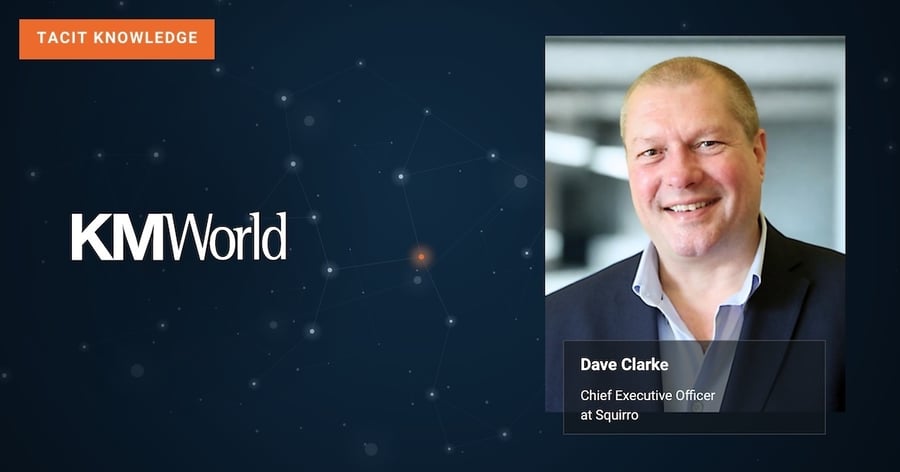

At KMWorld 2026, Squirro CEO Dave Clarke told a room of knowledge managers that enterprises are suffering from amnesia, and that the cure is a goal he calls enterprise omniscience.
We sat down with him afterward to unpack the argument: why tacit knowledge is the last hard problem in knowledge management, why retirements and AI make it urgent now, what Squirro has built this year to capture it in minutes, with people approving every piece before it is shared, and why he believes the field is close to cracking it.
Key Takeaways
- With search and classification much improved, tacit knowledge is the hardest problem left in knowledge management.
- Retirements and AI agents raise the stakes together: one takes knowledge away, the other needs more of it.
- Squirro's innovation team set out to cut tacit knowledge capture from weeks to minutes.
- Captured knowledge is shared only after the expert and a manager have approved it.
You Opened Your KMWorld Talk With Omniscience. Walk Us Through the Idea.
Dave: In the religious sense, omniscience means knowing everything that ever has been, is now, and ever will be. We don't need to go there. For knowledge managers, the useful version is access to all the knowledge inside our organizations. I call that enterprise omniscience.
Everything this community does, from knowledge audits and interviews to taxonomies, procedures, and communities of practice, serves the same purpose: getting what one person knows to everyone who needs it. Enterprise omniscience is where that work leads.
It's a worthy aspiration, and the breakthroughs of the last two or three years make me think it may be attainable, provided we solve tacit knowledge.
Your Talk Was Titled Around Amnesia. What Is Organizational Amnesia, and Where Does Tacit Knowledge Come In?
Dave: Knowledge splits into two kinds, explicit and tacit. Explicit knowledge is written down somewhere. Tacit comes from the Latin for silence: it's what goes unspoken. It's the understanding people carry around in their heads and never share, sometimes because they're hoarding it, far more often because nobody gave them the time.
Amnesia is the Greek word for forgetfulness, and it describes what happens to that knowledge. Everyone knows the saying that knowledge walks out the door when someone leaves. That's a huge and costly problem. The part people overlook is the knowledge that never leaves the building and still never gets shared, held by people who are sitting at their desks today.
Both are amnesia. And we will never get to an all-knowing enterprise if we can't capture and share what's tacit.
Knowledge Managers Have Worked on This for Decades. Why Is Tacit Knowledge the Problem to Solve Now?
Dave: Two pressures are arriving at once. Experienced people are retiring and moving on, and they take decades of judgment with them. At the same time, AI has its own appetite for context. An agent can only reason as well as the knowledge it can reach, and the undocumented part of how a business works is exactly what it can't reach.
The other reason is that the rest of the field has moved. When I look at the classic challenges in our discipline, findability and taxonomy lag sat at the top for years. With the right technology, I'd say poor findability is now largely a solved problem. At Squirro we've gone from semantic vectors to the semantic layer, to LLMs, RAG, GraphRAG, and this year agentic search, which applies multi-step reasoning to the search process, at scale, in heavily regulated industries.
Taxonomy lag comes down to the human effort it takes to build taxonomies and keep classification current. We now build AI agents that look at content and search behavior and suggest how to extend the taxonomy, with taxonomists deciding what goes in. I won't call it solved, but it's far better than it was even a year or two ago.
That leaves the two hardest problems at the bottom of the list: the tacit knowledge gap and the capture burden. That's where the inflection point is.
At the Start of This Year You Gave Your Innovation Team a Specific Assignment. What Was It?
Dave: A simple little assignment. Build a solution that captures undocumented tacit knowledge, structures and stores it so it's machine-intelligible and shareable, and cuts capture time from weeks and days to minutes. Where the team has got to is, for me, incredibly impressive.
The work runs along three lines. The first is extraction, which means mining ephemeral material: conversations, meeting recordings, the ephemera that normally never gets digested into proper information.
The second is elicitation. In traditional KM, interviews are an entire program: scheduled, lengthy, and separate from the day job. People push back, and fair enough; they want to get on with their work. With micro-elicitation, the AI asks a few short questions inside the workflow, while the person is doing the task, and most of the capture burden goes away.
The third is observation. We let AI infer from patterns of behavior, or from anomalies between data sources, and then ask the right person to explain what it sees.
Once You've Captured Tacit Knowledge, Where Does It Go?
Dave: This is a challenge we haven't really had before. Most of what our industry does operates over data or metadata in the broadest sense: search indexes, metadata repositories, all the RAG built on top of data. Capturing tacit knowledge means generating new knowledge. We're creating what was never written down, so we need a way to structure it.
We needed two things. The first is a home for long-form knowledge, beyond concepts and definitions. Think of articles, or nuggets. In April this year Andrej Karpathy published his vision for what he called the LLM Wiki, a way of building a wiki of what we know and what we think. It's a brilliant idea. The enterprise challenge is to run that as a collective, governed resource rather than an individual one.
The second is the graph. The graph wires everything together; it's the synapses of the corporate brain. A knowledge base and a knowledge graph working in concert are how we record and store tacit knowledge today, so it's readable by people and by machines.
What Does That Look Like When Someone Actually Leaves?
Dave: Take a hypothetical company, Northstar. Maria is retiring. As soon as that's known, AI agents start reviewing the policies and procedures Maria works with and the decisions she's made, and they identify gaps. Gap analysis becomes an automated function.
That kicks off a series of micro-capture interviews with Maria and with her manager, focused on the gaps in documented knowledge around her work. Each one takes minutes. The agents turn the answers into entries in the knowledge base and the knowledge graph.
What was tacit is now documented, in a new space built for it rather than buried back in the old policy folders. We have demos and videos of this running if anyone wants to see it.
How Do You Know What You've Captured Is Right?
Dave: Captured is not the same as trusted. Once tacit knowledge is captured, it needs to be tested, held to rigor, and approved by people, and AI can help run that process.
In the Northstar example, the AI detects differences between written policy and actual practice and goes back to Maria: "Why did you do this? Can you advise on that? Make a choice and help us understand." Those exchanges take minutes. The result is distilled into a draft for two approvals: Maria confirms it reflects what she knows, and her manager signs off that it's good to share.
Nothing enters the shared knowledge base without that human gate. The agents do the legwork of finding gaps and drafting, and people decide what becomes institutional knowledge. Every article then keeps its sources, the people who contributed, and the date.
You Got From Assignment to Working Demo Within a Year. How, and What Does It Take From Customers?
Dave: We didn't have to invent everything from scratch. We already had Squirro Neo, our agentic platform, and Synaptica, a long-established way of storing knowledge organization systems in standard formats. Bring those two together, add workflows built around knowledge capture, and you're in business very quickly.
Tacit capture depends on everything this industry has built over the years. You need search and chat, taxonomy and ontology, foundation models, and agent workflows you can configure without sending every change back to development. If an engineering department needs a particular set of questions answered in its own workflow, you should be able to configure that in minutes, with no code. And you need a place to store the result, which is the knowledge base and knowledge graph working together.
Then there are the people. You need sponsors and subject-matter experts, a governance process, and someone who owns the gap analysis. In practice that's a center of excellence. With a number of our clients, we act as their outsourced center of excellence for AI and work hand in glove with their teams to put these systems in place.
You Ended Your Talk by Saying We're Going to Crack This Soon. How Soon, and What Changes When We Do?
Dave: I think tacit knowledge is the inflection point we're at right now. We've moved a long way from amnesia toward enterprise omniscience, and this is the piece that has been missing.
When it's cracked, a retirement stops being a loss event. The knowledge a person spent decades building stays with the organization, reviewed and approved, and the AI agents working alongside the next generation can draw on it. That's good for the people who hold the knowledge too. For the KMWorld community, sharing knowledge is a vocation that gives the work real meaning, and these tools let that vocation operate at a scale it never could before.
I won't put a date on it. Personally, I believe we're going to crack it, and I think we're going to crack it soon.