
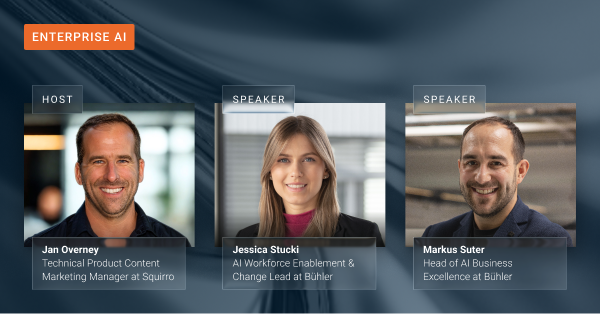

If you work in operations or IT at a manufacturer, you know how much of your team’s week goes into quotations, tenders, and customer requests that arrive by email, each slightly different, each handled by hand. Markus Suter of Bühler, a global technology partner for the food, feed, and mobility industries, described his company's quotation process in just those terms: repetitive and high volume.
AI agents can take on much of that work, and choosing your first one well makes every agent after it faster to deploy. Our 26-minute on-demand webinar, Proven AI Agents Driving Transformation in Manufacturing, shows how. You'll see two agents from the Squirro Agent Catalog running end to end, follow what happens after the first one goes live, and hear a short conversation with Markus and his colleague Jessica Stucki about how Bühler, whose AI agents are built on the Squirro platform, approached its rollout.
Key takeaways
- AI programs tend to slow down when each new use case starts from scratch.
- Squirro's catalog agents are built to work from trusted sources and keep a person in the loop for decisions that matter.
- Agents built on a shared foundation make each following deployment faster.
Why Does Every New AI Tool Feel Like the First?
You may have seen this pattern in your own organization. Finance buys a tool that reads invoices, and it works. Legal buys another to search contracts. HR adds a third for policy questions, and the service desk starts piloting a fourth.
Each one solves a real problem. Each one also brings its own integration work, its own security review, and its own procurement cycle, and none of it carries over to the next. So the fourth tool takes about as much effort as the first. It's one reason MIT's NANDA initiative's 2025 report, The GenAI Divide, found that just 5% of enterprise AI pilots deliver significant value.
What Do the Agents in the Catalog Actually Do?
The Squirro Agent Catalog is a set of ready-to-deploy agents, each mapped to a business function such as finance, HR, legal, sales, or operations. Each is scoped to go live in weeks, and all of them run on the same platform, so whichever one you start with becomes the base for the next. The webinar walks through two of them, both shown with sample data.
The first is an RFP agent. Give it a nine-page tender and it pulls out the questions, mandatory clauses, eligibility gates, and deadlines, then drafts answers using only your approved answer library, with a citation behind every statement. When the library has nothing on a topic, IBM FileNet in the demo, the draft says so and routes the question to a named expert with a due date. It doesn't guess.
The second, the InstaQuote agent, reads a customer email asking for spare parts and turns it into a quotation in SAP. It lays out its 11 steps before it starts, scores its confidence at each one, and flags anything it had to infer, like an item the customer mentioned in passing but left off the list.
A person approves before anything is written. InstaQuote stops at step six and waits. No quotation, notification, or record exists in SAP until an engineer reviews the line items and approves them. The original email is archived with the records, so the decision can be traced months later.
What Happens After the First Agent Goes Live?
The first deployment carries most of the setup. Someone has to build the system connections, settle authentication and the permission model, take the agent through security and governance review, and bring the right stakeholders together.
The second agent inherits much of that. Its new work sits on top of connections, approvals, and working relationships that already exist, and by the third or fourth agent, the share of new work is smaller still. Other departments can start on the same foundation, too. Finance might follow sales, with legal and operations close behind, and each line of work makes the next one easier.
Adoption follows a similar path. Every new agent needs its users on board, and that always takes some effort. But it builds on the trust, the training approach, and the stakeholder network the first deployment put in place.
What Did Bühler Find Along the Way?
Bühler now has three AI use cases in production that are powered by the Squirro platform. In the webinar, Markus, who led the initiative on the business side, explains why they chose a partner over another standalone tool: "We did not want to take or buy an additional isolated AI tool."
By the second use case, he said, "we were not starting from zero." The development, test, and production landscape, the SAP connection, and security and access were already in place, and the team knew each other. "With each and every use case, it gets more efficient and faster."
Jessica, who led adoption, describes how the team made users "co-creators rather than just recipients," listening to their input and keeping the focus on their daily work.
Where Would You Start?
The webinar ends on one question for your own organization: where is the friction highest right now? Look past the most strategic project and the one with the best slides. Find the process that is visibly broken, where someone would notice within a month if it were fixed. That's usually your first agent, and if it's built on the right foundation, it makes the second one easier.
Watch the on-demand webinar to see both agents in action and hear how Bühler approached its rollout, or browse the Squirro Agent Catalog and try them out yourself in the Squirro Demo Center.