
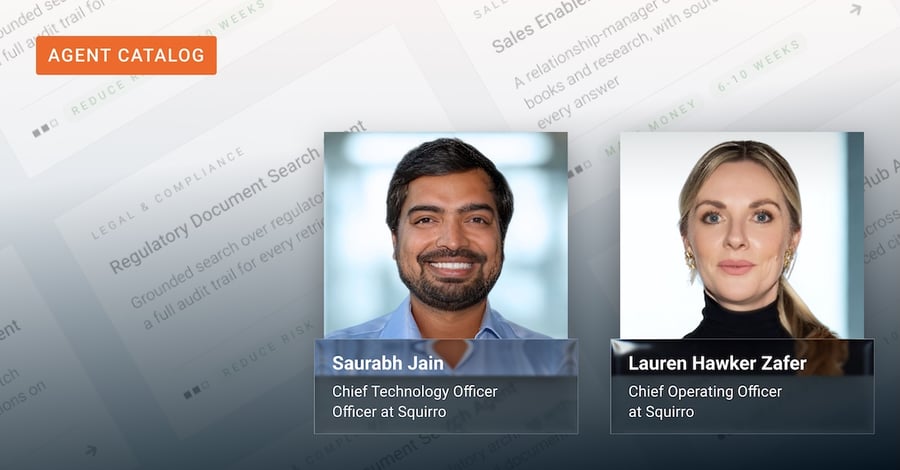

Most enterprise AI initiatives never scale beyond a pilot — a stall so common it has a name: pilot purgatory. The reasons are rarely the ones vendors talk about, and they usually have less to do with the software than with strategy. We sat down with Lauren Hawker Zafer and Saurabh Jain, the COO and CTO at Squirro, to discuss why enterprise AI strategy so often breaks down between pilot and production, and to hear them make the case for a more predictable path to scale.
95% of enterprise AI projects never escape pilot purgatory. What's going wrong?
Lauren: The reasons are not technical, they're strategic. Enterprise AI strategy tends to start in the wrong place – enterprises try to solve the biggest problem first. They scope a transformation program, convene a steering committee, hire a consultancy. Eighteen months and several hundred thousand euros later they have a slide deck, a pilot that worked in one department, but still no path to production because nobody agrees what production means. The 95% number isn't a story about AI failing. It's a story about enterprises buying AI the way they bought ERP in 2005, and getting the result that approach deserves.
Enterprise AI software usually means buying a platform first. You're arguing for the opposite. Why?
Lauren: Because that's how the customers we've worked with have actually succeeded. We'd sell a platform, but in practice most didn't deploy a platform – they put one use case into production, saw it work, and expanded from there. The platform was the right product. For many, it just wasn't where they needed to start. Buyers don't wake up wanting an AI platform. They wake up with a problem. We meet them there, solve it in weeks, and the broader platform follows once they've seen the value and want to do more.
Your argument rests on the idea that the right architecture compounds. What does that actually mean under the hood?
Saurabh: The first use case doesn't just solve a workflow, it lays a foundation. The connectors are built and authenticated. The taxonomy is tuned to your data, and the knowledge graph has started accumulating the relationships specific to your business. The permissions model mirrors your source systems. When the second agent arrives, it inherits all of that. And with each additional agent, the substrate becomes more and more powerful. The catalog is the visible part. The compounding is the actual product.
On AI vendor selection, you're up against specialists with sharper focus and lower prices. How do you win the first deal?
Lauren: Sometimes we won't, and we shouldn't pretend otherwise. But the buyer isn't really choosing between two ways to solve one problem. They're choosing between solving one problem in isolation, or solving the first of many with shared infrastructure. A specialist's price for use case one is a fine number to look at. The number that matters is the price, time, and risk of use case two, because the next specialist will again start from zero, with yet another round of evaluation, a new security assessment, and a new procurement cycle. Twelve months later the buyer has six specialist suppliers, six contracts, six data silos, and exactly the fragmentation they were trying to solve.
What about the technical evaluator who thinks they can just build it themselves?
Saurabh: Sure, they can get a demo working in a sprint. But wait until they try to get it production-ready in a regulated institution. What they're not pricing in is the governance layer, the permission-aware retrieval, the audit trail, and years of experience handling edge cases. The components are easy to assemble. The thing that survives a compliance review is not. Most teams discover the gap about nine months in, which is an expensive place to learn it.
What's the one question a CIO or COO should be asking themselves right now?
Lauren: What is it already costing you that your most expensive people spend a third of their day hunting for information the company already owns? Most leaders can't answer that. And if you can't measure the cost, you don't have an AI problem yet – you have a measurement problem. So measure it. Pick three teams, look at one week. Once you can say your analysts lose two hours a day to search, the decision stops being strategic and becomes arithmetic. And arithmetic gets funded. Vision rarely does.
And for the technical leader weighing this up – what's the thing that's easy to miss?
Saurabh: That the value isn't in any single agent; it's in what the second one inherits from the first. Most evaluations look at one use case and price it like a point solution. The question that actually matters is what the architecture does for you over three years: whether each deployment leaves something behind that makes the next one faster, or whether you're starting from zero every time. That's not visible in a demo. But it's the only thing that lets you scale AI across the enterprise instead of stalling at one.
Explore the Squirro Agent Catalog
Every agent in the Squirro catalog is scoped and built around a single business outcome – so you can start where the friction is sharpest and prove the value in weeks. Browse the full Agent Catalog online, or download it as a PDF to share with your team.
If this resonated, we recently ran a full webinar that goes deeper. "Building Enterprise AI That Compounds as It Scales" brings together our team on why enterprise AI stalls and how to build so it doesn't. Watch it on demand here.