


Most enterprise AI never reaches production. The figure people quote is around 95%, and the reason is rarely the technology. Projects stall because organizations start in the wrong place, without a roadmap that connects the first deployment to the second.
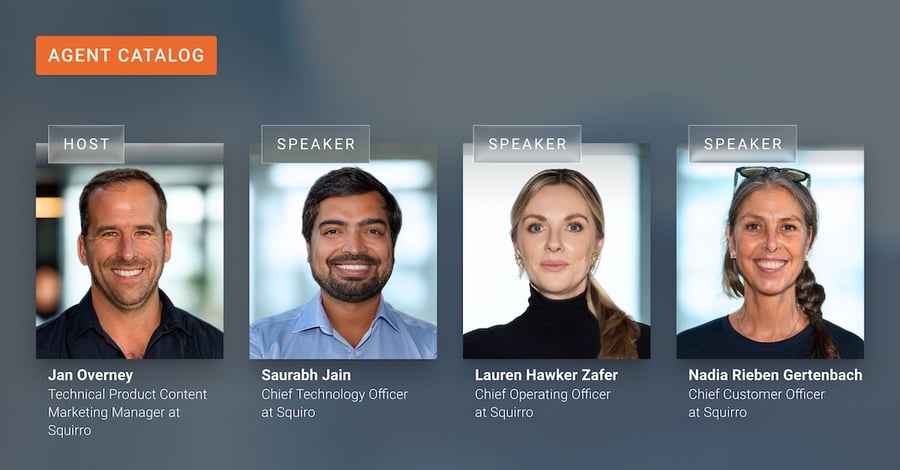
We recently brought together three people who see that problem from different angles – our VP of Sales for EMEA, our CTO, and our Chief Customer Officer – to work through what separates the enterprises that scale AI from the ones that stall. What followed was less a presentation than an argument, and a candid one. Here are six lessons from the session that stuck with me. The full webinar is on demand if you want the whole thread.
The Technology Works. The Project Still Fails.
Domenico Le Pera opened not with a statistic but with a chocolate factory. A Swiss manufacturer wanted an AI vision system to catch misshapen bars coming off the line, a clear and sensible use case. They never built it. At the end of that line, a human still had to physically pull the faulty bars and swap them out, so the AI would have changed nothing about the labor or the cost.
His point: "The technology works perfectly to solve the immediate problem, but if you don't look at the entire process, you can waste a lot of time and money solving a problem that won't yield a true return." It reframes the 95% number as a problem of where you aim, not whether the technology works. An AI proof of concept can succeed on its own terms and still deliver nothing.
Enterprises Take One of Two Paths, and Both Stall.
From there, Domenico laid out the trap. Organizations tend to approach AI in one of two ways. One buys a broad horizontal platform and tries to transform everything at once; the projects run too long and never prove ROI. The other buys a separate niche tool for every use case and ends up with fragmentation, a pile of tools that don't share data, a compliance team re-proving the same controls, and no single source of truth.
Two instincts, both reasonable, both stalling before production for opposite reasons. Naming that fork is what any AI implementation roadmap has to start from, because it is the choice that quietly determines everything downstream.
You Inherit One Foundation, and Every Agent Builds on It.
This is the hinge of the whole session. The alternative to both failed paths is to start from a real business problem, but to build so that the first deployment leaves something behind. Our CTO, Saurabh Jain, put the claim plainly: when the first use case goes live, it doesn't just solve one workflow, it establishes a reusable AI foundation the next agent inherits.
How much of a head start does that give the second agent? He put a number on it in the session, and walked through exactly which parts carry forward and which don't. That is the part worth hearing him explain rather than having me summarize it.
The Hardest Approval Is the One You Only Win Once.
The part of Saurabh's argument I hadn't expected was about trust, not technology. In a regulated institution, the hardest step of a first deployment isn't the model. It's clearing the security review, the compliance sign-off, and the governance approval that a risk committee has to grant before anything ships.
His point was that this cost is paid once. Once that foundation is approved, the questions that stopped the first project become routine for every deployment that follows. For anyone who has watched an AI project die in a risk committee rather than in testing, that reframing lands hard, and it is why AI governance belongs on the roadmap from the first use case, not the fifth.
The Technology Is Often the Easiest Part.
Then our Chief Customer Officer, Nadia Rieben Gertenbach, who heads the delivery department behind 200+ production deployments, turned the conversation on its head. In her experience, the biggest delivery challenges rarely come from the AI models at all. They come from the organization: stakeholder alignment on what "value" even means, data-ownership disputes, change management, and user adoption.
"The technology is often the easiest part; organizational readiness determines success." She had the deployment stories to back it up, including a central bank that deliberately paused a successful proof of concept, a decision that sounds strange until you hear her reasoning. That reasoning is in the recording.
The Winners Won't Have the Most Agents.
She closed on the line that best captures the hour: "The organizations that win won't have the most AI agents. They'll have the most reusable AI foundation."
It is a quietly contrarian thing to say in a market where every vendor counts agents. And it ties back to Domenico's two paths and Saurabh's architecture. The winners aren't the ones who accumulate the most tools. They are the ones who build a foundation each new use case can stand on.
What This Means for Your Roadmap
Read across the six and a pattern emerges. A working AI implementation roadmap doesn't start with the platform or with the tool. It starts with a business problem worth solving, deploys against it fast enough to prove value, and treats the first deployment as the foundation the next one inherits, rather than a one-off to be rebuilt from scratch.
There was more we didn't capture here: a live Q&A that got into pricing, into why AI projects really take as long as they do, and into a customer example where the second and third deployments ran an order of magnitude faster than the first. If the six lessons above resonated, the full conversation is worth the hour.
Watch "Building Enterprise AI That Compounds as It Scales" on demand here.