

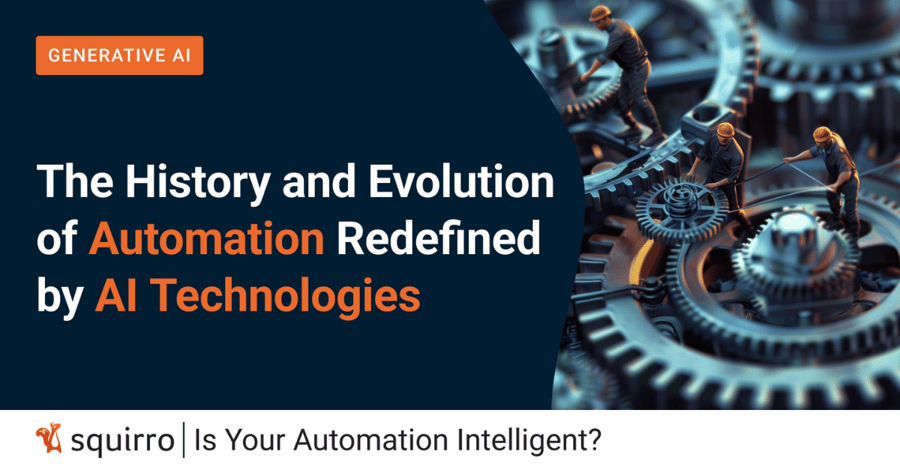

At its core, automation enables systems, operations, or mechanisms to function independently without direct human intervention. Pursuing this concept from its modest beginnings to today's hyperautomation has shaped technologies, transformed industries and economies, and left a significant mark on the labor force. From the early gears of industrial machinery to sophisticated algorithms, the journey of automation leading up to enterprise-grade generative AI and agentic workflow automation reflects a relentless pursuit of efficiency, safety, and innovation.
Strategic process automation applications permeate various facets of our lives, from our smart home assistants regulating temperature in our homes to chatbots on websites, robot manufacturing, and the accelerated realm of autonomous vehicles.
In today's landscape centered around intelligent automation, we are at the advent of the AI-powered evolution spanning all data-centric sectors. As every modern industry pivots to become an information-driven, rapid data processing enterprise powered by autonomous workflow orchestration, tomorrow's digital landscape becomes ripe for hyper-automation.
To gauge the full impact of the digital revolution, we must draw insights from the history of automation in order to harness a viable automation strategy.
Industrial Revolution: The First Wave of Task Automation
Industrialists sowed the seeds of Automation during the Industrial Revolution, a period marked by the transition to new manufacturing processes and the introduction of mechanical production facilities. The invention of machines that could perform tasks previously done by hand, such as the spinning jenny and the steam engine, initiated the first wave of task automation. These machines didn't operate entirely without human oversight, but they significantly reduced the labor required to produce goods, laying the groundwork for the concept of enterprise automation.
The 20th Century: The Groundwork for Robotic Process Automation (RPA)
With a jump to the 20th century, we witnessed the rapid advancement of technology and the rise of automation, particularly in manufacturing. In the early 1900s, Henry Ford popularized and pioneered the development of the assembly line, which paved the way for the mass production of goods with minimal human intervention.
This era also saw the advent of computer technology and robotics, pushing the boundaries of what could be automated much further. The introduction of programmable logic controllers (PLCs) in the 1960s marked a significant milestone. This was the spiritual predecessor to modern Robotic Process Automation (RPA), enabling the automation of industrial processes with unprecedented precision and flexibility.
The Digital Age: Information Technology and AI Automation
Furthermore, the advent of the digital age accelerated the evolution of automation exponentially, with information technology and artificial intelligence (AI) playing pivotal roles. The Internet and advancements in computing power expanded the possibilities of autonomous systems beyond physical tasks to include data processing, analysis, and decision-making.
AI automation and machine learning algorithms have enabled the creation of systems that can learn from data, adapt to new situations, and make decisions with minimal human guidance.
The 21st Century: The Intelligent Automation Platform Scaling Automation at Speed
Today, intelligent automation is permeating every facet of our daily lives. From autonomous vehicles (self-driving cars) navigating our roads to smart home devices managing our living environments. Drones conduct aerial surveys, robots perform surgeries with precision beyond human capability, and GenAI-driven automation platforms personalize our digital experiences.

The Internet of Things marks a significant milestone as integrating IoT devices further enhances connectivity, reshaping communication and engineering landscapes. We witness more tech innovation based on this trend: becoming more autonomous and interconnected, where a thriving digital ecosystem is formed. Cloud migration also accelerates digital transformation, empowering organizations with real-time data analytics. The convergence of AI and machine learning enables end-to-end automation, making a profound turning point in how we harness our data technology.
Crucially, it enables the rise of intelligent document processing and AI-driven workflow orchestration – key components that allow disparate systems to “talk” to one another without constant manual oversight.
The Future of Automated Intelligence: Hyperautomation Solutions
Finally, we find ourselves at a critical intersection: navigating the way forward at a decisive moment as emergent technologies continue to deliver exponential growth in proportion to imminent risks. Startling advances in artificial intelligence have propelled pioneers like Mustafa Suleyman, to the urge of "Containment for AI'' in public conversation, referring to the 20th Century's Cold War strategy to a New Threat.
For instance, the future of hyperautomation trends promises even greater integration of autonomous technologies into our daily lives, potentially leading to smart cities, fully automated transportation systems, and AI-driven governance. Thus, this future arrives with unprecedented challenges, posing ethical, legal, and social challenges that must be navigated carefully and contained within AI guardrails. As we respond to the new wave of innovation and continue advancing the frontiers of automation and beyond, human oversight remains an essential part of the collective evolution.
Conclusion: Implementing AI-Driven Automation Solutions Tailored For Success
The history and evolution of automation reflect a fascinating journey from mechanical automation to AI-driven process automation, even in the harshly regulated financial industry, unpacking astonishing technological discoveries. As we stand on the brink of further groundbreaking developments, automation will undeniably continue to shape the future growth trajectory of any industry.
As a must-have feature in any company's AI strategy, the economic incentive for integrating AI-powered automation is evident. Yet, the critical determinant lies in implementing within an enterprise setting to harness its ultimate benefit.
Gain Expert Guidance on Enterprise Solutions:
C-level leaders must proactively implement enterprise-grade solutions to elevate operations and ensure the secure deployment of intelligent automation technologies.
For Seamless Implementation of AI Enterprise Solutions tailored to your unique needs and timely guidance on navigating changes in your industry, connect with Our Specialists and schedule a free demo - book your demo here.
Our Generative AI Buyer’s Guide is designed for decision-makers looking to advance with AI-powered Enterprise Solutions tailored to success.
Drive Your Enterprise Forward: Access Buying Guidance from a Leading Solutions Provider and get the full perspective here: "The Successful Enterprise Search and Generative AI Buyer."