

"Semantic layer" has become one of those terms that comes up in nearly every enterprise AI conversation. You'll hear it from vendors and from your own data team, usually with the promise that a semantic layer makes AI more reliable. The term is rarely explained, and it's often used to mean two quite different things.
Here's the short version: A semantic layer is where your organization agrees what its words mean, and where your data and documents get linked to those meanings, so that every AI tool works from the same definitions. You don't need one to get started, because grounded retrieval (an AI that answers from your indexed sources and cites them) works without it.
But when your AI keeps getting answers wrong because one term means three different things in three departments, a semantic layer is usually the most direct fix.
What Does "Semantic Layer" mean in AI?
A semantic layer is a shared set of business definitions that sits between your raw sources (databases, warehouses, wikis, documents, and spreadsheets) and the people and AI tools that use them. It gives key business concepts one agreed definition and connects both structured data and unstructured content to those definitions. Search, RAG, assistants, and agents can then reuse the same meanings instead of each guessing on its own.
The reason the term causes confusion is that it grew up in two different places. Data and analytics teams usually mean a metrics layer, also referred to as a data warehouse semantic layer, which defines terms like "revenue" once so every dashboard and query calculates it the same way. Knowledge management teams, on the other hand, use it to mean taxonomies, ontologies, and knowledge graphs, which do the same job for the concepts in your documents.
In the enterprise, questions tend to cross the line between the two. "How much of our revenue comes from clients whose contracts allow early termination?" needs an agreed definition of revenue and an understanding of contract clauses in the same answer. That's why we treat the semantic layer as one layer covering both.
Semantic Layer vs. Metrics Layer vs. Knowledge Graph
Ontologies and knowledge graphs both belong to the knowledge layer, so the middle column also shows where each one fits inside a semantic layer.
|
Metrics layer |
Knowledge layer |
One semantic layer |
|
|---|---|---|---|
|
What it defines |
Metrics, dimensions, and how tables join |
Concepts, synonyms, and relationships between entities |
Both, governed in one place |
|
Data it covers |
Tables in warehouses and databases |
Documents, wikis, email, and contracts |
Structured and unstructured content |
|
Typical question |
"What was net revenue in DACH last quarter?" |
"Which contracts include a change-of-control clause?" |
"Which clients with a change-of-control clause also missed their revenue targets?" |
|
What goes wrong without it |
Two dashboards show two revenue figures |
The right document is missed because it uses a different word |
An answer that is right in one system and wrong in the next |
|
Common standards |
Metric definitions kept in code or configuration |
SKOS, OWL, and RDF |
Both |
As an aide, you may have also heard about "context graphs," especially in connection with AI agents. While a semantic layer records what your terms mean and how concepts relate in general, a context graph records what actually happened in specific cases: which decisions were made, and why.
Agents benefit from both, and we've written separately about what a context graph is and how it gives AI agents memory.
Why Use a Semantic Layer for AI?
In our experience, a large share of wrong enterprise AI answers trace back to ambiguous business language, and that's the problem a semantic layer is built to solve. The model does what it was asked, but picks the wrong one of several reasonable meanings of a term.
Ask sales, finance, and customer success what an "active customer" is. Sales might count anyone with a signed contract. Finance may count only accounts that were invoiced this quarter, while customer success counts whoever logged in last month. An AI assistant asked "how many active customers do we have?" has no way to know which one you meant, so it chooses and sounds equally confident whichever it lands on.
Newer models handle this better than earlier ones did, but even they have to guess which meaning you had in mind, because the ambiguity lives in your organization's terminology.
Documents have the same problem. One loan agreement might use the term "financial covenant," another "maintenance undertaking," and a third the German term. A retrieval system that matches on wording finds some of them but misses others. It directs AI to the right book but can't guarantee that the AI knows which section of the book you meant.
How Does a Semantic Layer Work? An Example, Step by Step
To see how the semantic layer works, let’s follow one question through the system and add each piece only when required by the question. Here’s an illustrative query inspired by questions we see in banking deployments.
A relationship manager at a bank opens the bank's AI assistant and types:
"Which of my mid-market clients in the automotive supply chain have covenants that trip if revenue falls 15%?"
The assistant runs on grounded retrieval, or retrieval augmented generation (RAG). It searches the bank's indexed credit agreements, client files, and financial data, then writes an answer with citations.
Step 0: Without a Semantic Layer
The assistant finds agreements that contain the words "automotive" and "covenant." It misses agreements where the clause is called a "financial maintenance undertaking." It includes a tire retailer, because "automotive" appears in its sector description. It interprets "mid-market" however the model sees fit, and it compares revenue figures that were calculated differently in different files.
As is so often the case, the AI delivers a fluent and completely plausible answer. It cites real documents. But it's wrong in at least these four ways.
Step 1: Shared Definitions
First, the semantic layer defines clearly what business terms mean. "Mid-market" takes the revenue band set in the bank's credit policy. "Revenue" means one specific measure, for example consolidated revenue over the past twelve months, calculated the same way everywhere.
This is the metrics side of the layer, and it delivers the first benefit most teams notice: sales, risk, and finance get the same number when they ask the same question.
Step 2: A Taxonomy for Vocabulary
Next comes vocabulary. A taxonomy records the concept "financial covenant" once, with its preferred name and every alternative label the bank's documents actually use, such as "maintenance covenant," "financial undertaking," and the equivalents in other languages. The SKOS standard has fields for exactly this: one preferred label and as many alternative labels as you need.
Now the assistant can match on the concept, whatever words a given lawyer chose in 2017. Agreements it used to miss start showing up.
Step 3: An Ontology and Knowledge Graph for Relationships
A taxonomy says what things are called. An ontology says how they relate. Here, it records that a client has subsidiaries, that each subsidiary belongs to a sector, and that "automotive supply chain" includes component makers and excludes retail. The tire retailer drops out, and a parts supplier held through a subsidiary drops in.
Those relationships get populated through annotation. The platform reads incoming documents, tags each one with the concepts it mentions, and links it to the right entities in the knowledge graph. When annotation finds something new, such as a subsidiary acquired last month, it proposes the addition, and a taxonomist reviews it before it enters the graph. That review step keeps the graph accurate as it grows.
Annotation also makes the answer traceable. The assistant can show which concept it matched, which entity it linked, and which clause in which document it used.
Step 4: Permissions
The relationship manager asked about their own clients. Permissions-aware retrieval applies the bank's access rights at the moment documents are retrieved, so files outside the manager's book never reach the model at all. We've written more about how access controls survive chunking and indexing.
With this last piece, the answer can stand up to an auditor as well as a colleague.
What You End Up With: A Semantic Layer Architecture
The same definitions, vocabulary, and relationships now serve every tool that sits on top: enterprise search, the assistant, and any agents you build later. You define "financial covenant" once, and every project after that inherits it.
That reuse is also where the cost argument comes from. A model that doesn't have to guess tends to need fewer attempts, and fewer tokens, to reach the right answer. And each new project starts with the definitions already in place.
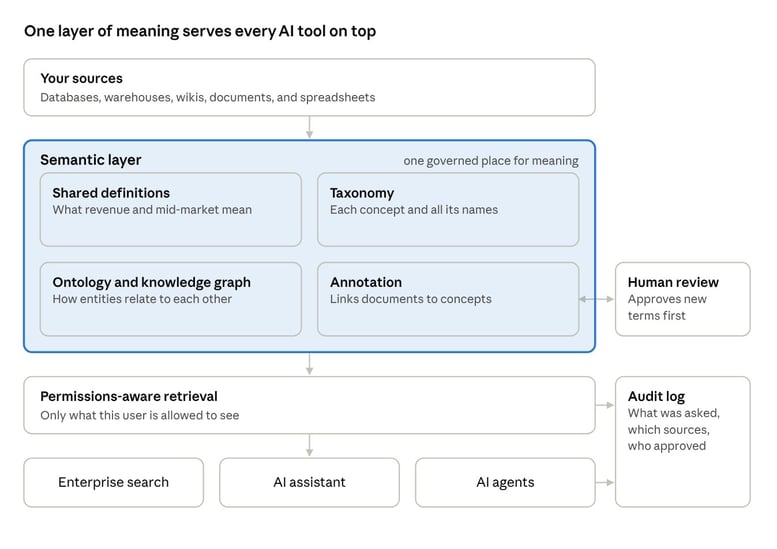
Semantic layer architecture in a GenAI system, from sources to AI tools. Read it top to bottom: meaning is added once, access rights are applied at retrieval, and every AI tool above draws on the same layer while the audit log records what happened.
How Does a Semantic Layer Relate to RAG and GraphRAG?
Retrieval augmented generation (RAG) is how an AI finds relevant sources and cites them in its answer. A semantic layer tells that retrieval what your words mean. You don’t need a semantic layer for RAG to work. But with one in place, retrieval can match on concepts and relationships as well as on words and phrasing.
Most RAG systems today rely on vector search, which finds passages that are similar in meaning to the question. Often, they combine that with good old keyword search, so-called hybrid search. That's powerful, and for many questions it's enough. Where it struggles is precision: two clauses can look alike to a vector index and mean different things to a credit officer, and one concept can hide behind five different specific names.
GraphRAG combines the two approaches. Hybrid search finds candidate passages, and the knowledge graph adds what the index can't see on its own: which entity a passage is about, what that entity is connected to, and which concept it belongs under. We’ve written a longer explainer on how GraphRAG works.
Graph-based retrieval helps most with three kinds of questions: broad ones that span many documents, such as "what are the recurring risk themes across this portfolio?", ones that depend on how things relate to each other, and highly specific ones, such as troubleshooting machines for which documentation exists for dozens of very similarly named product variants.. For a simple lookup, like finding the notice period in one contract, plain vector retrieval usually does fine.
Do You Need a Semantic Layer?
Not always. If your AI answers questions over a focused, well-maintained set of documents, and the key terms mean the same thing to everyone who uses them, grounded retrieval on its own may well meet all your needs. An HR policy assistant for one country is a good example. Adding a semantic layer there would cost effort without changing many answers.
The picture changes when wrong answers start to follow a pattern. The table below maps the patterns we see most often to their likely cause, and to whether a semantic layer is the right fix.
|
What you're seeing |
Likely cause |
Does a semantic layer help? |
Where to start |
|---|---|---|---|
|
Two teams get different numbers for the same metric |
The metric is defined differently in different places |
Yes |
Define your most-used metrics once |
|
The AI misses documents that clearly answer the question |
One concept, many names |
Yes |
A taxonomy with synonyms for that domain |
|
Answers confuse related entities, such as a parent company and its subsidiaries |
Relationships aren't recorded anywhere |
Yes |
An ontology for the entities that matter most |
|
The right document is retrieved, but the conclusion is wrong |
How the model reads or reasons over the source |
Rarely |
Evaluation, prompting, or model choice |
|
Relevant documents never show up at all |
They were never connected or indexed |
No |
Connect the missing sources |
|
Users see content they shouldn't |
Access rights aren't enforced at retrieval |
No |
Permissions-aware retrieval |
As you’ll see in the last two rows, semantic layers aren’t a silver bullet. Plenty of AI accuracy problems have simpler fixes that are worth addressing first.
The order also depends on your data. If most of your questions are about numbers that already live in a warehouse, a metrics layer may be a smart first investment, and a knowledge graph can wait. If most of your knowledge sits in contracts, reports, and correspondence, vocabulary and relationships will matter sooner.
In the deployments we've seen, ownership decides success as often as software does, because someone needs to own each definition. If nobody in your organization can say who decides what "active customer" means, a semantic layer will only record the disagreement more neatly.
What Does a Semantic Layer Do for AI Agents?
An assistant answers questions. An AI agent takes steps: it drafts, files, flags, and routes. That raises the stakes on meaning, because a misunderstood term can now trigger a wrong action. Agents also tend to chain their steps, with each one building on the result of the last. A term misread in the first step gets carried into every step after it, so a small error early on can shape the whole outcome by the time a person looks at it.
A semantic layer gives agents governed context. The agent knows not only what "covenant breach" means in your organization and which entities it applies to, but also which rules constrain what it may do next. In a recent webinar, our colleague Jan Ebner laid out how knowledge graphs can be used to govern agentic workflows: "The LLM proposes, and the graph governs what is allowed to happen."
A knowledge graph isn't a precondition for deploying an agent. Many useful agents run on grounded retrieval alone. The graph sharpens what an agent can do safely where the work depends on categories, relationships, or rules.
Where the human stays in the loop
Back to the relationship manager. Suppose an agent takes the covenant answer one step further and drafts a check-in note to each client that is close to a threshold. Every draft goes to the relationship manager, who edits and approves it before anything is sent. The audit log records the original question, the concepts and documents the agent used, the permissions applied, and who approved each message. The agent does the research and the first draft. The manager stays accountable for what reaches the client.
For a longer look at how knowledge graphs keep agents on track in production, see our piece on agentic AI architecture from pilot to production.
How Do You Build a Semantic Layer? Where to Start
Begin with one domain and the vocabularies you already have. The requirements for a semantic layer are modest at the start: one domain, a set of real test questions, the vocabularies you already own, and a named owner for each definition.
The organizations we see succeed treat the semantic layer as something that grows one domain at a time. Trying to model the whole enterprise before the first user asks a question tends to stall.
- Pick one domain where wrong answers are expensive. Credit, compliance, and claims are common first choices in regulated industries, because the cost of ambiguity there is easy to see.
- Write down 20 to 30 real questions people ask in that domain, along with what a correct answer looks like. This becomes your test set, and it keeps the project anchored to real work.
- Collect the vocabularies you already own. Most organizations have more than they think: glossaries, product catalogs, the definitions behind regulatory reporting, and the spreadsheets someone in operations has maintained for years.
- Keep taxonomy and ontology separate. Settle the vocabulary first (what things are called), then add relationships (how they connect). Use consistent naming throughout, so the next domain can reuse what you built.
- Bring it into one governed place. Squirro Graphite imports existing vocabularies in standard formats, including SKOS, OWL, RDF, JSON-LD, and CSV, and can convert legacy spreadsheet taxonomies into structured schemes. Annotation then links your documents to those concepts, with a person reviewing anything new.
- Measure against your test set, then expand. Run the same questions before and after. When the answers improve, move to the next domain and reuse the definitions that carry over.
If you take one thing into your next team meeting, make it these questions:
- Which terms cause the most arguments in our organization?
- Who owns their definitions today, if anyone?
- When our AI assistant gets something wrong, do we know why?
- Which of those failures would shared definitions actually fix?
The answers will tell you whether you need a semantic layer, and where it should begin. If you'd like to go further on step 3, our whitepaper on how your existing enterprise taxonomy can support GenAI walks through turning the vocabularies you already have into a working foundation.