

Before you approve your next enterprise AI investment, verify what your system is actually drawing from. The model type and the user interface matter far less than the underlying retrieval infrastructure. This data layer determines exactly what information your GenAI tools use when generating an output.
Too often, this foundational architecture gets deferred while business units scope flashy use cases. But assuming your data is automatically ready for an LLM is precisely how enterprise pilots face significant friction at scale. To build a system that is defensible to regulators and clients, you need a deterministic framework for AI grounding.
The Capital Shift in Enterprise AI Infrastructure
Gartner’s market overview for enterprise AI search notes that assistants and agents require AI-ready content to deliver accurate outputs. Preparing high-quality content for AI applications is the primary reason the market for this dedicated layer reached $2.9 billion in 2025 and is projected to expand to $4.1 billion by the end of 2028.
This capital isn't moving toward sleeker user interfaces. It is flowing directly into the enterprise AI infrastructure required to guarantee absolute AI source attribution and deep AI traceability. In highly regulated environments, the moment someone asks where an automated answer originated arrives fast.
Architectural Choices for Effective AI Grounding
Organizations typically evaluate three distinct paths when designing their AI retrieval architecture, as shown in the image below. Most enterprise AI purchases land in the second or third category by default. Not because they are the right architectural choice — but because they arrive bundled with tools organizations are already buying.
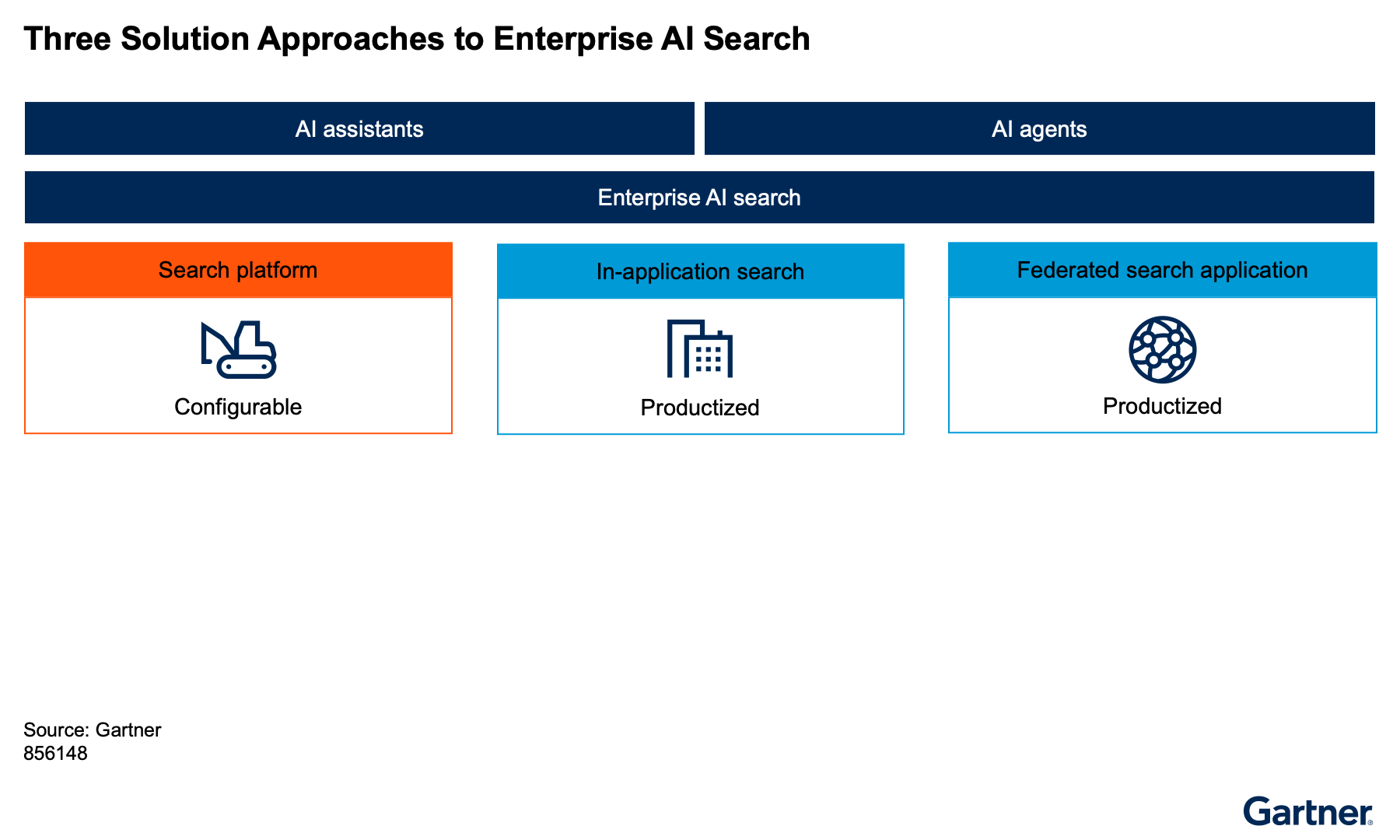
Here's the catch - built-in suite search only accesses information living inside that specific suite. Meanwhile, federated search brokers queries across disconnected silos, introducing an untraceable logic that compounds as your enterprise AI content scales. Neither approach gives your AI stack a single, centrally governed knowledge layer where permissions, enrichment, and retrieval are consistently enforced, regardless of where the data originated.
Dedicated configurable platforms solve this by indexing fragmented sources, enriching data against an enterprise ontology, and enforcing role-based access. This creates a secure system where every result is traceable to a verified source. For executive stakeholders, this level of AI explainability is precisely what makes an automated system defensible to a board or a regulator.
Beyond Standard RAG: The Move to Semantic Retrieval
Retrieval augmented generation (RAG) is the typical starting point for maintaining model accuracy. It pulls relevant files and feeds them to the model as context.
But standard RAG processes are fundamentally non-deterministic - identical queries can surface completely different results depending on how the index was built. Even when the correct document is found, an ungrounded LLM may extract the incorrect detail from the text.
To mitigate this risk, sophisticated enterprise AI governance combines knowledge graphs with RAG frameworks. This method, known as GraphRAG, gives your AI retrieval layer a precise, semantic retrieval capability for proprietary data. By anchoring your automation in a structured knowledge graph, you unlock reliable agentic workflows that maintain rigorous human oversight for edge cases.
The Core Evaluation Before Executive Sign-Off
If your team is preparing to deploy an automated agent framework, the underlying retrieval infrastructure needs a rigorous audit before executive sign-off. If the AI provenance of your data is unclear, everything built on top inherits that foundational instability.
Evaluating your choices requires focusing heavily on mandatory features like security processing. The architecture needs to enforce user permissions during the indexing phase - not as an afterthought at query time. That is how you prevent data leakage.
Selecting the right enterprise retrieval layer is ultimately a calculation of operational risk. A deterministic platform anchors your automated workflows in verified context, allowing your specialist teams to remain firmly in the loop. They manage the high-value edge cases. The AI handles the rest.
Your Next Step in Enterprise AI Governance
Ensure your GenAI investments are built on an auditable, secure foundation. Download the Gartner Market Overview for Enterprise AI Search - Read the Full Report